
The Wisdom of Slowmaxxing
Why slowing down leads to better judgment, wiser choices, and a more human future.

Last week when I was in Berlin, I spent 3 peaceful hours on a solar-powered boat meandering through the water and a rainstorm.
Vacation changes your sense of time. So does being in another culture, especially one where daily life seems have more room for lingering (I wrote more about this here).
On the slow boat ride, I didn’t look at my phone and I ended up reflecting and journaling. I thought about work, relationships, and what I had been learning, and realized how much I had to digest from the past few months.
I thought about the idea of digestion, where the body takes time to actually process the things that come into it. The body decides what to keep and what to let go of, and what will fuel it.
Maybe wisdom and discernment work the same way. But in most of our lives, there's little space for that digestive process.
The Missing Space
Coming home to the US, I talked with people about European vacations, slow summers, and was fed Instagram posts reflecting my post-vacation emotions like…
“Forget Hot Girl Summer, What About Slow Girl Summer?”
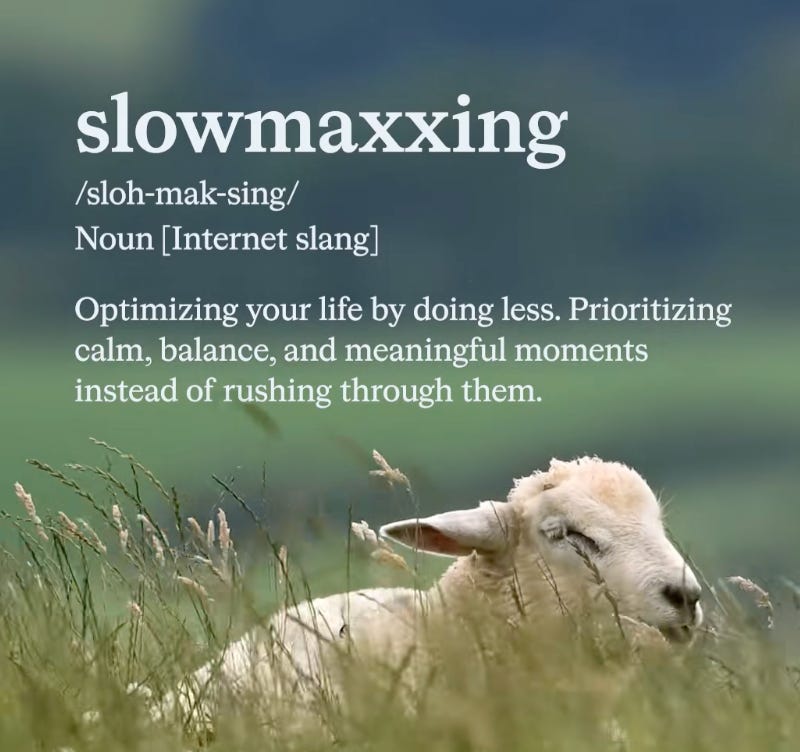
Nearly everyone I talked to seemed to say some version of: ugh, things are moving too fast.
There’s never enough time to finish your work, respond to every text, care for the people and animals we love, get to those creative projects, or feel caught up.
On top of that, we have built a culture in which speed signals importance and competence. A crowded calendar says you’re someone who is needed. Also, rest and vacations can become another project to optimize and win at.
Artificial intelligence has entered this already accelerated reality with an even more frenetic rhythm.
An investor recently told me they read AI news every morning from 5:00 to 7:00 and still do not feel caught up.
In other technological revolutions, there were years of social adaptation; industrialization changed labor, education, family life, and politics over generations.
With AI, we are compressing that cycle dramatically.
Teachers are creating their own AI policies before their school has one. A product manager is reinventing their own job before anyone knows what the new role should become. A nonprofit leader feels compelled to get everyone Claude accounts because suddenly all the funders are asking for their AI strategy. Parents are already forced to decide what forms of AI use are healthy for their children on their own.
The feeling isn’t limited to people trying to keep up with AI. Even many of the people building it are now asking for more time.
This week, 1,268 people who work at frontier AI companies signed a statement asking the U.S. government to deliberately slow down and pace AI development, to give time for governance, safety and security measures to catch up. OpenAI said in a statement,
“To realize AI’s potential, industry, government, and society at large may need the option to buy time to address emerging risks, develop security measures, and strengthen oversight.”
But some people hear the idea of “buying time” and think it’s naïve. The train has already left the station, they argue, and the brakes are broken. Others point out the irony that many of the people now calling to pace AI are themselves helping build it.
But then who is setting the frenzied pace?
Everyone and no one, it seems.
We see a lot of finger pointing: It’s the markets! No, it’s geopolitical pressure! No, it’s god-like egotism! No, it’s the government!
It’s probably all of these forming into a collective soup that is hard to parse out.
And we might be left feeling like there’s nothing we can do.
Slow Down to Speed Up
The feeling of “not having time” can distort judgement, and tint everything you look at.
I know that when I am stressed, my sense of urgency gets projected onto everything, even things that are not actually urgent.
It’s Sunday, but I am still racing through CVS to get the prescription, annoyed at the long line, my shoulders tense and my hands clutching the shopping cart.
Yes, finishing the errands is important, but there’s no deadline, this is just the pace from my week still running at full speed.
This does not mean that urgency is imaginary or that individuals are able to fix it. Those that want an AI pause are arguing that this can only happen as a collective effort across the field and that it’s beyond one company, team or individual’s actions. Collective pressure and policy is often what turns the tides on a wider scale.
But pace is also a norm that spreads itself through each of us.
We bring urgency into our decisions, our organizations, the example we set for children and it keeps rippling out.
Pretty soon, it can feel like we’re all racing toward a future we never chose, as if it were a foregone conclusion.
But often we’re on the default path only because we haven’t taken the time to see if there’s another way. Sometimes we need to take a breath to digest what’s actually happening; and allow us to step outside the feeling of inevitability long enough to see that choices still remain. That’s where wisdom enters.